




An advancement in robotic flight shows how advanced electronics and reconfigurable mechanisms are enabling machines to mimic the complex wing motions of birds, paving the way for smarter aerial systems.
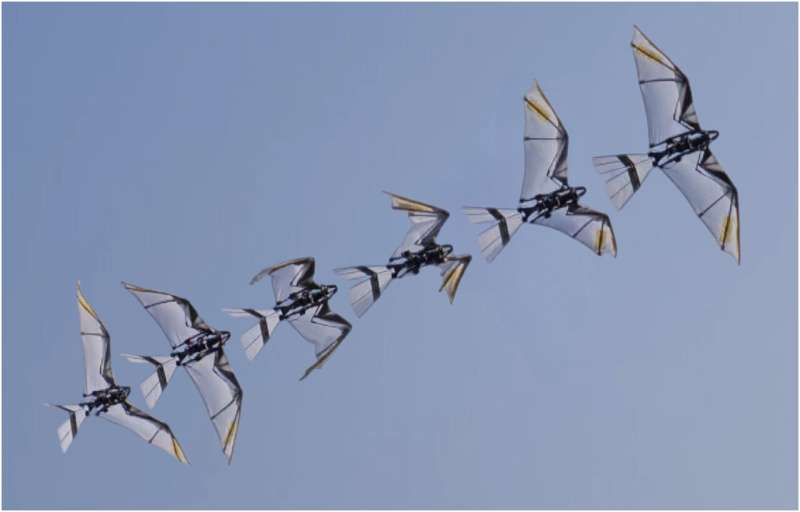
A flapping-wing robot that mimics the mechanics of birds has achieved a milestone in bio-inspired flight: self-takeoff and sustained low-speed flight. Researchers in China unveiled RoboFalcon 2.0, a bird-like robot that combines flapping, sweeping, and folding motions within a single wingbeat.
Earlier prototypes, including the team’s 2021 RoboFalcon, could cruise effectively but failed at two critical challenges: unaided takeoff and low-speed stability. The upgraded model, weighing just 800 grams, integrates reconfigurable mechanisms that couple three degrees of freedom (DOF) wing motion—flapping, sweeping, and folding—enabling more lifelike aerial performance.
Unlike most robotic flyers, which typically rely on simpler one-DOF wing kinematics inspired by insects or hummingbirds, the new robot replicates the more complex mechanics used by birds and bats. By tucking its wings during upstroke and executing ventral-anterior downstrokes, the robot generates lift and thrust sufficient for takeoff—essentially reproducing the bird-style launch long considered a benchmark for aerial robotics.
Wind tunnel tests, computer simulations, and real-world flights validated the design. The researchers found that adjusting wing sweep directly influenced lift and pitching momentum, aiding both takeoff and in-flight control. Flight demonstrations confirmed that the coupled flapping-sweeping-folding (FSF) motion allows fine-tuned pitch and roll adjustments while preserving thrust.
The achievement addresses one of the biggest hurdles in flapping-wing robotics: balancing lift, thrust, and control in a compact design. Still, challenges remain. The robot lacks yaw control, limiting its hovering stability, and its energy efficiency lags behind smaller insect-inspired robots and natural birds. The team also notes that adding a tail elevator would improve stability at higher speeds.
Despite these limitations, the design represents a significant advance for avian-inspired robotics, particularly for studying flight mechanics and developing more agile aerial systems. By showing that bird-style self-takeoff is possible with reconfigurable mechanical systems, the project opens the door to applications in surveillance, environmental monitoring, and search-and-rescue robotics where silent, low-speed maneuverability is crucial. The study authors emphasize that their underactuated design simplifies attitude control while more closely emulating vertebrate flight. For robotics engineers, it marks a rare case where mechanical ingenuity narrows the gap between engineered flight and the elegance of the natural world.


